Roughly a year ago, I started an idea to dream about something better for a neighborhood I was familiar with. Things were rough – storm debris littered the lands and the trauma still fresh in those minds. The anniversary of that storm came and on that anniversary, another hurricane was projected to head towards our mountains. Many residences I talked to discussed the fear of that event and the uncertainty of how to move forward. I spent the day volunteering at a local garden that was rebuilding after the storm., helping rebuild garden beds, fix fencing, and helping design a new educational pavilion for the garden. I knew the way everyone was thinking had changed. They looked at the nearby creek with more, lets call it reverence. People were still afraid of the nature, but it was evolving into something different. People were rethinking their relationship to nature. No longer was it something that occupied paintings and selfies, it was something to consider into their relationships and lives.
Nature was something to guide their next steps.
The storm inspired me to obtain a permaculture certification. Like architecture, the permaculture field is another generalist discipline and we learned about too many fields for the short classes. The class highlighted a million new ways to interact with natural systems, many (who am I kidding, nearly all) ignored in my architectural training. The permaculture training was revelatory.
Nature favors abundance.
The Appalachian mountains are a land of absurd abundance. That’s actually one of the reasons its hard to grow crops in the region – too many things want to eat what you’re growing. We saw abundance of variety when it came to how to exist in the landscape and outside of the systems that remove that abundance to grow grass or park cars. These precedents caused me to rethink my relationship with architecture and the kinds of work I do in my professional space. My relationship with stormwater (rain) changed the most, but that’s a story for another day.
Lastly, I’ve been talking to neighbors about this idea of resilient towns. I’ve gotten a lot of blank stares as they listen. They love the idea of being resilient, that words means a lot to them, particularly to those that call these mountains home. But when I talk about what that looks like in a community, they have a problem seeing what that actually looks like. Imagines of seawalls and even biodomes come up – more brutalist ways to project our expectations onto the landscape. Those are purposely left out from the future ‘master plans’ I have thought about for this project because I think the simpler the solution, the more resilient it is.
Well, I met someone whose eyes weren’t blank. Instead, hers lit up.
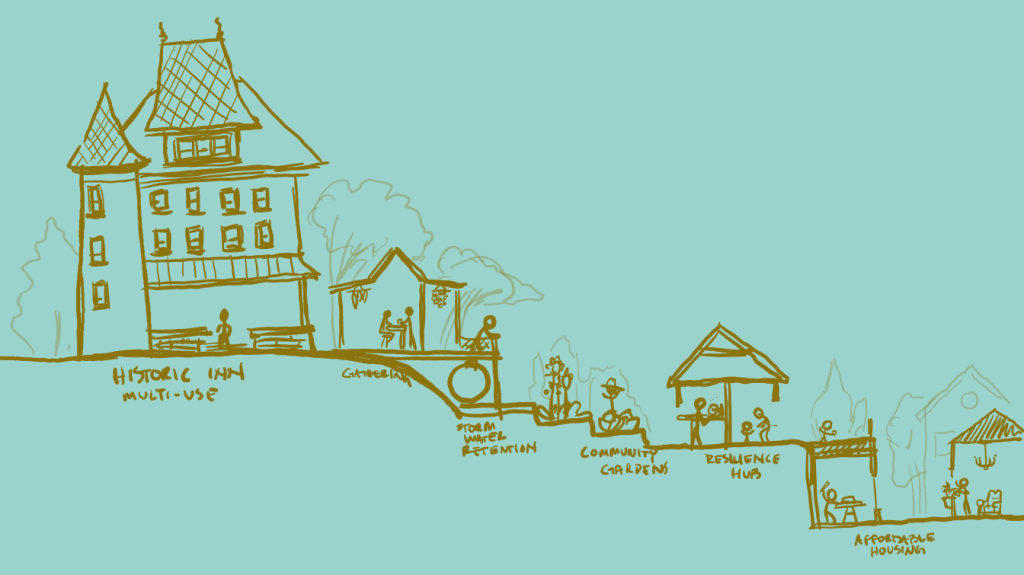
She lived in Osceola Lake. She owned the old Copper Crest Inn (renamed now the to Osceola Lake Inn). She wanted to become a community hub for resiliency and identity. I’ve been helping develop a plan for that hub for a few months now.
osceola lake village
I’ll share more about the project as we near the final approvals from the City and what the final iteration looks like. Whatever form it takes, I could have never imagined this form without the collaborative practice of architecture. Also, we have to abide by the existing zoning ordinances and all that I said this project would be immune from. That definitely changed some things (boo parking minimums).
Anyways, the project has developed into a incredibly diverse and communal project. The inn itself will contain some of the expected fixings of a hotel – a bar and cafe. Some of the existing rooms are being renovated to remain guest quarters. Some of the rooms are being converted into co-working spaces. Some of them will keep the existing ghosts.
On the ground floor, mixed between the cafe and bar will be a local consignment shop, showing off the wares from the local makers and artists. Oh yeah, the long, detached guest rooms are being turned into artist studios. A new wellness center is being constructed to provide community health initiatives but also providing a space for more wellness programs like acupuncture, yoga, massage, and meditations. A new outdoor bar houses a place for wellness tinctures and drinks to be crafted and sold, and to process herbs from the formal herbal gardens.
A dense grouping of residential units are also being proposed, mainly duplexes, around an open space courtyard (no cars allowed), incentivizing communal activities. A new resiliency hub is proposed smack dab in the middle of the entire campus. Housing more amenities to help the residential units be smaller (thus more affordable) by housing more communal programming that allows for neighbors to leave the house and meet each other, to have board game nights, communal dinners, fix each others broken things. The hub is geared to be used daily, but designed to be used in case of disasters. Solar panels keep the lights on and let neighbors (near and far) charge devices and communicate. Additional food storage options allow for food reserves to be preserved and used in the communal kitchen. Bathrooms have showers, laundry is on site, and even a workshop is present for helping with repairs or mitigation. A community garden rounds off the list of amenities, feed with stormwater cisterns on site.
This project has allowed me to release I don’t need the world to collapse before we can build these things. People WANT these things once they see them as an option. Once people see it as an option, they will pressure the governing bodies to allow them with less headache. Luckily, the planners I’ve been working with agree on the community needs with this project, but the zoning ordinance has been, dogmatic.
looking forward
I’ll continue addressing the design for Osceola lake as a neighborhood, highlighting some of the concepts and exploring potentials therein. I also want to move to another neighborhood, one that isn’t as unique -a five lane highway with rows of fast food restaurants and a dying mall with LOTS of parking. It’ll really stretch the imagination but these kinds of landscapes pollute most towns and cities. I also think, given the globalized nature of the businesses there (multi-national corporate entities) that they will be some of the first to exit the area in case of a disaster since they have no roots.
I think each neighborhood will glean some new insight and tool that will make the approach to the next neighborhood design even better. Afterall, that’s what this whole experiment is about, being better.
 resilient towns
Leave a comment