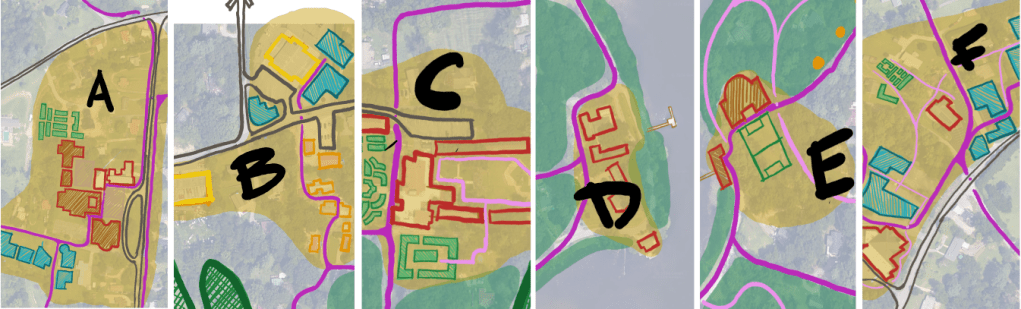
In order to facilitate a more resilient community at the lake, new community hubs are reinforced from existing structures and resources. Future additions can be added to continue to provide access to community-defined needs, such as barbers, bakers, and bike technicians. I’ve identified (6) potential hubs I’m going to call libraries. I’ve identified them as follows:
A. Learning Library
B. Repair and Create Library
C. Copper Crest Inn
D. Ecology Center
E. Play Library
F. Social Library
learning library (A)
Education is a fascinating program to design for. I also think the program needs a redesign itself. Smaller schools dotted throughout the area seems to be a decent solution for resilient towns so some form of an educational program made sense to include in the Osceola Lake redesign. The merits of this design philosophy has plenty of merits and critiques that are worthy of a whole conversation but I’m interested what functions make sense for this community.
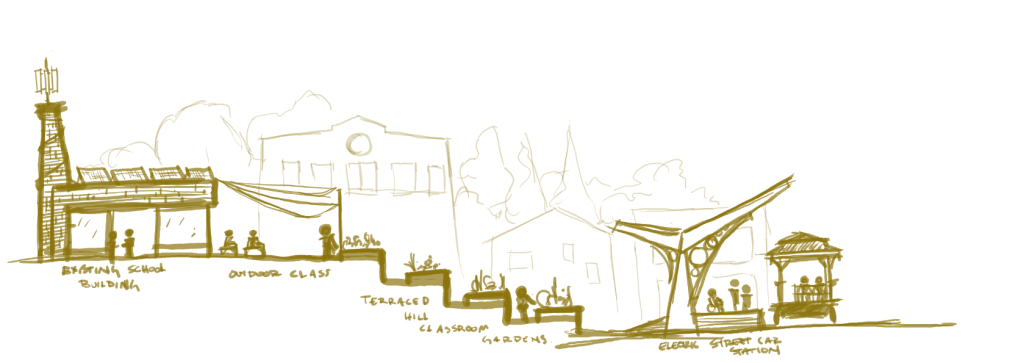
This neighborhood actually had an old school house nearby. Most of the classrooms are demolished but the existing cafeteria and gym still stand. Unassuming single story brick structures guess at the feel of the campus that once stood. We’ll reuse the still cleared land as the grounds for a new learning library.
The learning library may serve like most modern libraries. A collection of resources freely available for the community to utilize and aid in the users educational needs. You have meetings spaces that can be used for clubs or classes. You have storage of educational items like chemistry sets, telescopes, computers, books, paints, canvas, and whatever the community values. You’ll have spaces for educators to collaborate and design curriculum. Spaces for students to study and gather and experiment.
Given the climate of the region, and the access to ample water and nutrients, gardening remains a focus for the community. Educational gardening facilities, such as garden beds, greenhouses, and access to food forests allow students to train and experiment with the local ecology and techniques.
The learning library will be one of the more trafficked community hubs in Osceola Lake, and will draw more program pieces that serve crowds. These might look like small commercial districts near college towns. The multi-generational student base of a learning library means the adjacent support businesses would be a bit more diverse than bars and restaurants of modern college towns. Small businesses could also serve as an extension of the learning library, providing hands on learning experiences for students. They could also serve as gallery spaces for artists works.
While mass transportation doesn’t penetrate deeply into Osceola Lake, there should still be one or two hubs where the regional street cars can stop and drop off and pick up passengers. I’ll talk more about the street car network in a later post but the region had street cars that branched off from the train stations to better connect the neighborhoods. Modern interpretations of this network could see electric streetcars perform these same routes without the need for rails and on existing roadways. The learning library makes a great candidate for a local street car connection, further increasing the communities desire to consolidate new community amenities in this block.
repair and create library (B)
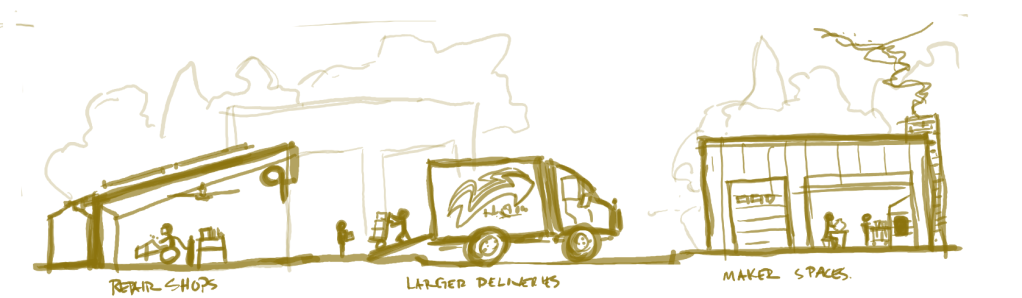
Close to the learning library, currently stands a couple of old car mechanic shops across the street from a fire station. This seems like the ideal location to reconfigure the existing structures and spaces to serve the communities manufacturing needs. A big part of a resilient community is making sure the appliances and machines utilized by the community are functional. In modern culture, this means buying a new fixture when the old breaks. When your stove breaks and the new one is made in Korea, that isn’t very resilient.
Repair centers make more sense in a resilient town. This entails quite a bit. The community need skilled technicians, tools, parts, and depending on the tools required, energy. Certain repairs might be a bit specialized for every community to house an expert and certainly there would be more specialized repair shops in larger communities, but a community this size should be able to most common repairs such as welding a break on larger equipment, or replacing computer components.
Creation should also be a component of this philosophy. Many of the components of normal life could be manufactured by local artisans. Soap, clay vessels, clothing, simple tools, housing elements, could all be produced as needed for the community by the community – depending on available skills of the communities residents. This is fueled by the proximity of the learning library. Trade skills could be taught at the repair and create library block, increasing the communities self sufficiency.
The repair and creation of goods within the block has a certain level of hazard to it. The storage of needed materials, the inherent danger of certain tools, and the debris of these activities warrant an increased diligence. This block is physically separated from the rest of the community, but placed in close proximity of the fire house. The repair and create library also sits on the main access road and thus can be easily accessed by emergency vehicles and deliveries alike. These buildings are also constructed of non-combustible materials. Further design considerations should be in mind when renovating. Access to main water infrastructure means fire sprinklers are available.
The repair and create library serves as the industrial base of the community. While certainly standard goods can be produced here, the combination of the learning library and the create library could generate a new class of trained artisans. Woodworkers could refine their craft and start manufacturing beautiful shutters for the residents. Welders could start prototyping unique bike frames to accommodate unique work challenges within the community. Potters could develop unique glazes from local materials. All these local developments would help develop and define the communities culture and start to produce a local sense of pride and ownership.
final notes
These blocks help define the communities resilience as it pertains to their skills and knowledge. Maintaining a skilled and educated work base is critical to a communities success and resilience. These blocks will not make the community entirely self reliant, and I think that is not the goal. There should be encouraged guest educators and makers, to showcase their unique knowledge and skills, and inspire the community into new ways of thinking and making. Likewise, community members should also be encouraged to travel to other communities to share their communities successes and failures.
These blocks could be seen as how the community works. How they work in both information and trade based skills. These blocks allow for people in the community to work where they live. To allow for their work to have a direct impact on them and their neighbors. This impact will increase residences satisfaction in their jobs. Increased job satisfaction leads to increased productivity. Since we aren’t trying to push our stock numbers up on the SP500, increased productivity can mean more than just creating more for the sake of more. Workers can spend time refining their craft, coming up with innovations, or heaven forbid, more down time. That sounds better to me.
I’ll cover the additional blocks in future blog posts. These two already generated enough content and I want to celebrate each block with the same amount of attention. These two blocks are closely tied together, and each pair moving forward has their own partnership as well. That seems sufficient reasoning for separate posts.
 resilient towns
Leave a comment