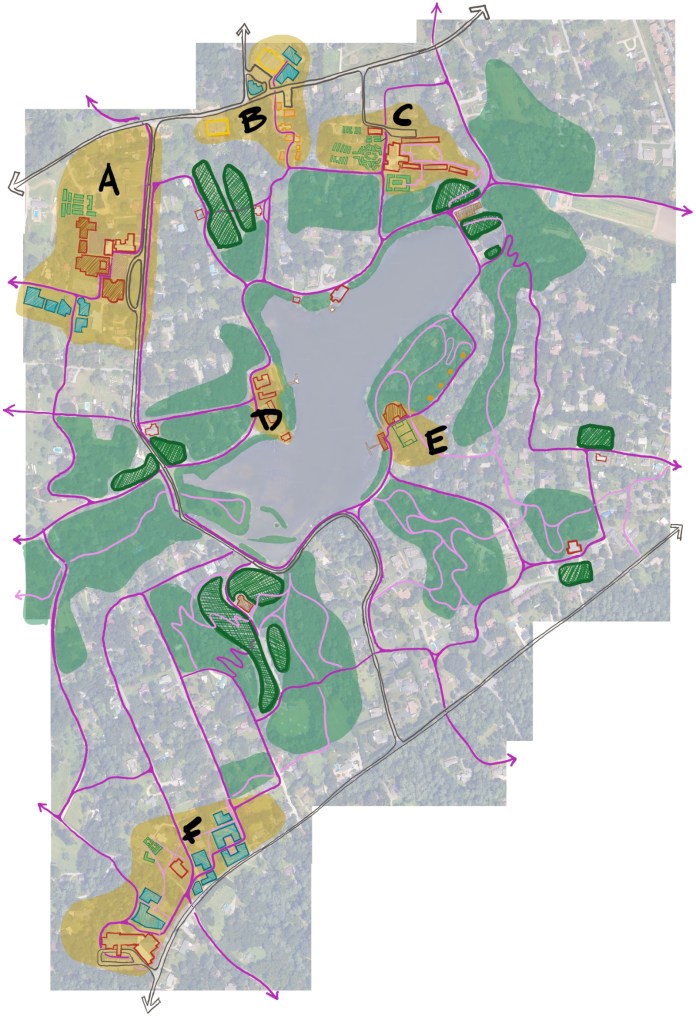
The future neighborhood of Osceola Lake will maintain its primary roll as a residential region, focusing mainly on the immediate needs of those inhabiting the location while preserving the ‘natural’ habitat (yes, the lake is manmade, but the lake has somewhat naturalized). The region depends on outdoor recreation and many of their residents depend on the outdoors to serve as their exercise and recreation.
The population lives in mostly existing housing, mainly of current existing single-family residences. Most of the housing is relatively modest in size with most houses sitting around 1,400 square feet. As residents find themselves spending more time outside, either gardening or walking/biking on the local trails, more of their houses will start to become disused. This opening of space will allow for roommates or family to move into spare bedrooms, inherently boosting density. The increased density means that additional spaces will need to created to serve the expanded community.
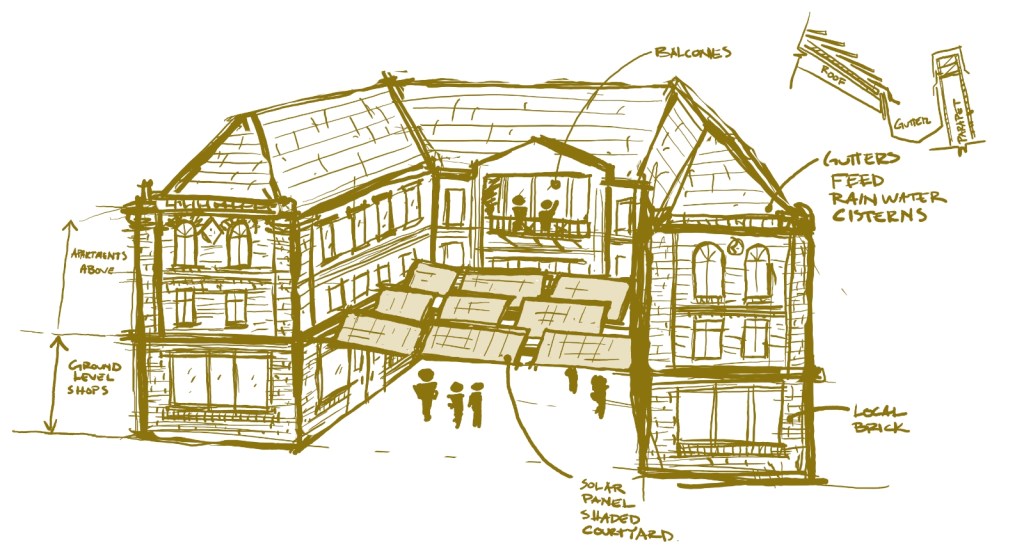
In the yellow districts highlighted in the site plan above, new community serves will be added. Small shops housing handmade items such as ceramics, clothing, bakeries, and artists (blue buildings). Apartments can be integrated into the new structures to help better facilitate better accessible accommodations for the neighborhood, keeping those in need being closest to their daily needs and community fixtures.
The green overlay represent preserved areas. These areas will support local wildlife and habitat. Trails (light pink) will be built on old roads and driveways where present and provide ample opportunity for connecting neighbors and leisure. The preserves will also gift the community wood for cooking and crafts and food in the way of foraged wild foods such as mushrooms, nuts, and berries.
The dark green patches represent food forests. These are designed with permaculture in mind, tall nut and fruit bearing trees such as pecan, hickory, cherry, plum, persimmons, paw-paws, apple, jujube dates, and peaches (the region is great for fruiting trees, we still get good frost hours). Lower fruiting bushes like hazelnut, pomegranate, and blueberries fill out below, then vines, like raspberries, hardy kiwi, wineberries, then herbaceous layers like more traditional vegetable and fruiting plants, then root crops like carrots, turnips, radish. These food forests will be geared more towards perennials and larger species to allow for smaller gardens to focus on the lower layers of permaculture design like vines, herbaceous, and root crops. These types of crops are also easier to consume closer to the residences. The more personal gardens allow for personal preference to take hold, allow for experimentation and allows for greater distances between beds to help preserve seed integrity for seed saving.
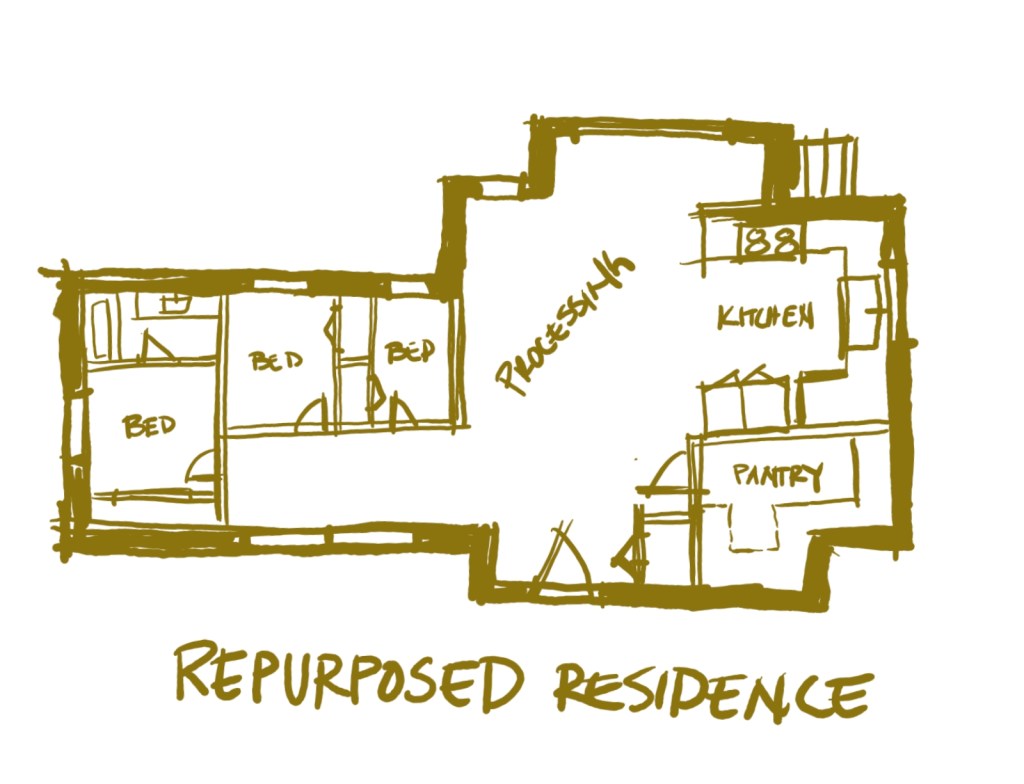
To help maintain the food forests, community garden centers will be nearby, utilizing existing houses were present. These centers will hold tools for maintaining the forest, harvesting the bounty, maintaining the house and any additional built environment within the forest such as compost bins or greenhouses. Reusing residences gives food forests access to a kitchen, allowing for a space to process and store the harvest directly and even give a place for worker(s) to stay overnight.
These forests are connected with low-capacity roads (dark pink). These roads are intended to only support bikes and pedestrians on a daily basis, and emergency vehicles – well, during an emergency. These roads exist in the footprint of existing roads where present, and can be enhanced based on community the road serves. This could be paver stones or bricks, or medians, roadside planting, lighting (dim, downcast lights to protect the night sky from light pollution). The low-impact roads connect to the main connector roads (grey) that serve the immediate area.

The connector roads frame the neighborhood to the north and south with a singular road driving through the middle. The main community districts (in yellow) can be found near these roads or even have dedicated offshoots to special locations. A few drop offs allow for mass transit in the way of an old street car that connects the neighborhood to other hubs including Hendersonville and Brevard. Connector roads will also allow for deliveries of larger goods to supply the community maker spaces and allow for residents and visitors to move between communities.
Each of these community centers, labeled A-F will be discussed in greater depth in later posts. A quick review of the concepts for each center is:
A. Learning Library
B. Repair and Create Library
C. Copper Crest Inn
D. Ecology Center
E. Play Library
F. Social Library
Each of these community centers will allow the neighborhood to take care of each other. The centers will be designed with stricter building standards to serve as shelters during extreme weather events. They will all contain basic community functions including community kitchens, food stores, first aid services, social spaces for meeting and civic functions. They will then specialize in their respective functions, either providing resources to encourage curiosity, measure and identify environment concerns, or just allow residents to play a game of ping pong.
summary
The neighborhood has restored the lake to foster local wildlife and recreation. People can be found walking along trails through the restored woods, eyes trained on the stump piles looking for any evidence of Shiitake mushrooms starting to fruit. They are enjoying the sun on standup paddleboards that are carefully stored and maintained in the Play Library’s dockyard. Ducks quack as the paddleboarders get too close and take off in flight, startling the paddleboarder, causing them to topple over into the lake. There is no fear of getting ill from the water, there was a meeting from the Lake’s ecologist earlier in the week where water testing results were shared. The lakes water has been cleaned through a recent shoreline restoration planting project that the local Learning Library helped organize with the ecologist. Plants were grown in neighborhood greenhouses to ensure they would respond well to the local microclimate.
Another resident rides their cargobike north to the Repair Library, cargo basket filled with old appliances neighbors dropped off to be opened up and investigated by the neighborhood tinkerers. Arriving at the library, a box car is parked in front, unloading salvaged parts from appliances that were deemed to be salvage. A pallet of new batteries are also unloaded and are already being loaded onto small electric cargo carts to take off to the solar fields by the dam. A few tinkerers are putting away gloves, ready for lunch. They settle on heading to the
Another resident rides their cargobike north to the Repair Library, cargo basket filled with old appliances neighbors dropped off to be opened up and investigated by the neighborhood tinkerers. Arriving at the library, a box car is parked in front, unloading salvaged parts from appliances that were deemed to be salvage. A pallet of new batteries are also unloaded and are already being loaded onto small electric cargo carts to take off to the solar fields by the dam. A few tinkerers are putting away gloves, ready for lunch. They settle on heading to the Copper Crest Inn where the inn’s kitchen garden has been selected by some traveling chefs to showcase new recipes they are trying out. The tinkerers take the long way to the Inn that takes them to the food forest just south of them. They load up on peaches, knowing the trees are absolutely swarming with fresh fruit right about now – and that these peaches will leave a lasting impression on the visitors at the Copper Crest Inn.
This is not an idle neighborhood that only sees activity as people leave and come from their jobs. The roads aren’t dominated by the same older retired resident and their aging dog. The yards aren’t idle say for the loud leaf blowers. This neighborhood is ripe with neighborly interaction. The day is filled with reasons to leave the house and be socially, physically, mentally active. Many of the needs are being taken care of by neighbors – tinkerers fix those headphones that have been meaning to get replaced, gardeners are starting seeds for the next succession of broccoli plants, woodworkers are building new shutters for that house that got hit by termites.
This neighborhood is connected and vibrant. There is a freedom of choice in lodging – denser blocks or more distant housing for those looking for more isolation. There are a multitude of occupations for it’s residents to enjoy that are a walking distance away. Free transit allows for residents to leave and visit other locations – each of those locations housing their own form of guest housing like the historic Copper Crest Inn. Food is abundant, the water is clean, the forests are lively, and families are supported.
Food is local. Jobs are local. Family is local. Friends are local. Recreation is local. Creation is local. This is resilience.
This is better.
 resilient towns
Leave a comment